
What is a 90-day challenge?
A fixed window gives a commitment a visible beginning and end. It can make daily expectations easier to audit because the action, completion rule, tracking rule, and missed-day response are chosen before the first difficult day.
The format can organize writing, studying, reading, creative practice, reflection, focus, or another appropriately chosen action. It does not prescribe one category and it is not the name of one universal workout program.
90-day challenge rules at a glance
People often search for “the 90-day challenge,” but that label is used for many unrelated fitness, money, reading, and discipline programs. There is no single universal rulebook. A clear personal challenge answers these six questions before Day 1:
- Choose one action.Name the behavior you intend to repeat, not only the outcome you hope to reach.
- Define completion.Use an observable finish line such as “write 300 words,” not “be productive.”
- Set the dates.Count the start date as Day 1 and calculate the ninetieth included calendar date.
- Choose strict or flexible tracking.Decide whether one miss ends the attempt or remains visible inside the same 90-day window.
- Record the result honestly.Check in on the required day and do not backfill an action that did not happen.
- Precommit to the response.Write what happens after a miss and what you will review when Day 90 ends.
Use the free 90-day challenge calendar and Day 90 calculator to turn the date rule into an exact schedule.
Keep an outcome goal separate from the daily tracking rule. “Finish a draft” is the outcome; “write 300 words before closing the workday” is an action you can record honestly each day.
Observable rule
Write 300 words before closing the workday. The finish line can be checked without interpretation.
Vague rule
Make progress on my book. “Progress” can change meaning after a difficult day.
Need candidates first? Use the free habits-to-track chooser, run one rule for seven days, then return to write the contract.
What 90 days cannot guarantee
The popular “21/90 rule” should not be presented as a scientific law. Treat 90 days as a clear contract length, then evaluate the actual record at the end.
Strict versus flexible rules
Strict challenge
Completion must occur on every required date. A miss ends the attempt. The benefit is clarity; the cost is that the rule may be unsuitable when planned exceptions are necessary.
Flexible challenge
The same calendar window continues after a miss. You may track missed dates, weekly totals, or predeclared rest days. The contract must state what completion means.
What a 90-day discipline challenge means
“90-day discipline challenge” is a descriptive phrase, not one standardized program. Here, discipline means following a rule you chose, completing one appropriately sized daily action, and recording the outcome honestly for 90 calendar days. It does not automatically require a diet, workout plan, punishment, or a long list of extreme tasks.
Write the challenge contract before Day 1
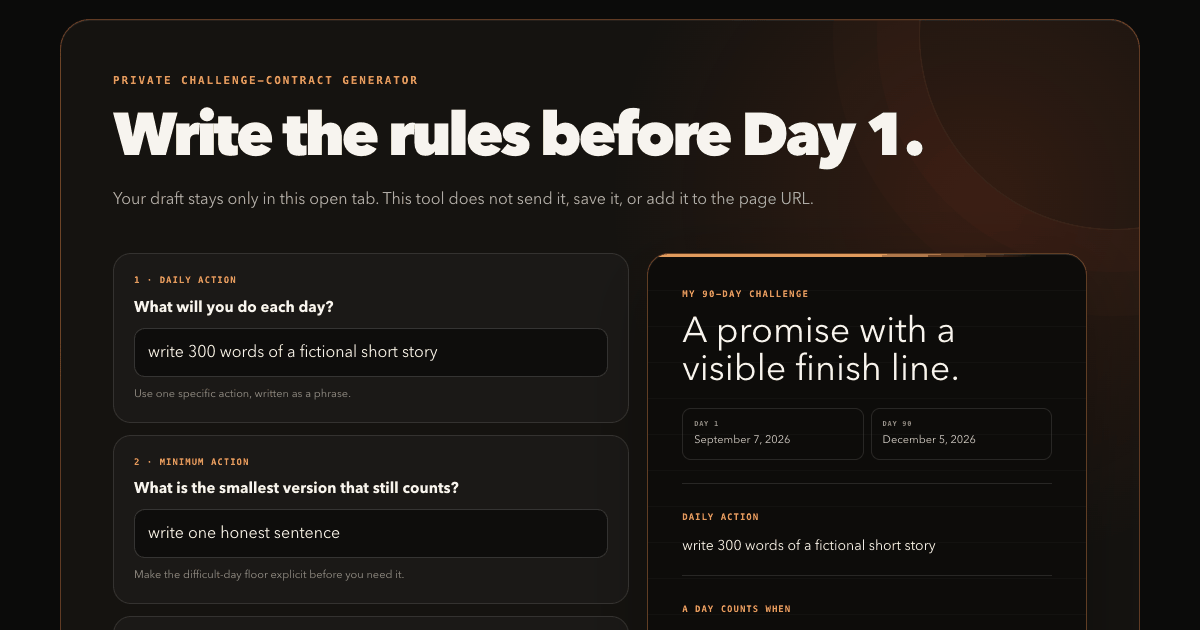
I choose to [daily action] from [Day 1] through [Day 90]. A completed day means [observable finish line]. My tracking rule is [strict or flexible]. If I miss, I will [continue, restart, or review the rule]. I will record the result honestly rather than backfill a day that did not happen.
Keep the primary action singular and observable. You can still live a complex life; the contract needs one completion decision that is easy to answer truthfully.
Calculate your Day 90 dateEight challenge examples
Who should modify an unforgiving rule
Use a flexible rule when health, disability, caregiving, shift work, travel, recovery, planned rest, or another real constraint makes consecutive daily completion unsuitable. A counter should never override safety or qualified care.
If tracking increases distress, shame, compulsive behavior, or unsafe choices, stop or choose a different structure. This guide is not medical or mental-health advice.
What happens after a miss
Follow the contract you wrote. A flexible window can continue with the missed date visible. A strict attempt ends and can begin again with a new Day 1. Either way, record what happened and choose one concrete protection for the next day or attempt.
Use the five-minute reset planSources and methodology
- Lally et al. (2010), European Journal of Social Psychology
A real-world habit-formation study showing substantial variation in modeled automaticity. It does not establish 90 days as a universal threshold.
- Official 75 HARD rules
The creator’s rule page identifies 75 HARD as a separate 75-day program with five prescribed daily tasks and a Day 1 restart after a miss.
This guide uses the habit study only to reject a universal timeline and the official program page only to prevent challenge-name confusion. Appy Labs, LLC wrote the rules, examples, and contract structure used here.
90-day challenge questions
What are the basic 90-day challenge rules?
Choose one measurable daily action, define completion, set Day 1 and Day 90, choose strict or flexible tracking, record each day honestly, and decide the missed-day response before starting.
Why 90 days?
It creates a finite, visible commitment with one defined end date. It is not presented as a universal scientific threshold.
Is the 21/90 rule scientifically established?
No universal rule shows that 21 days starts a behavior and 90 days automatically makes it permanent.
Must the challenge be consecutive?
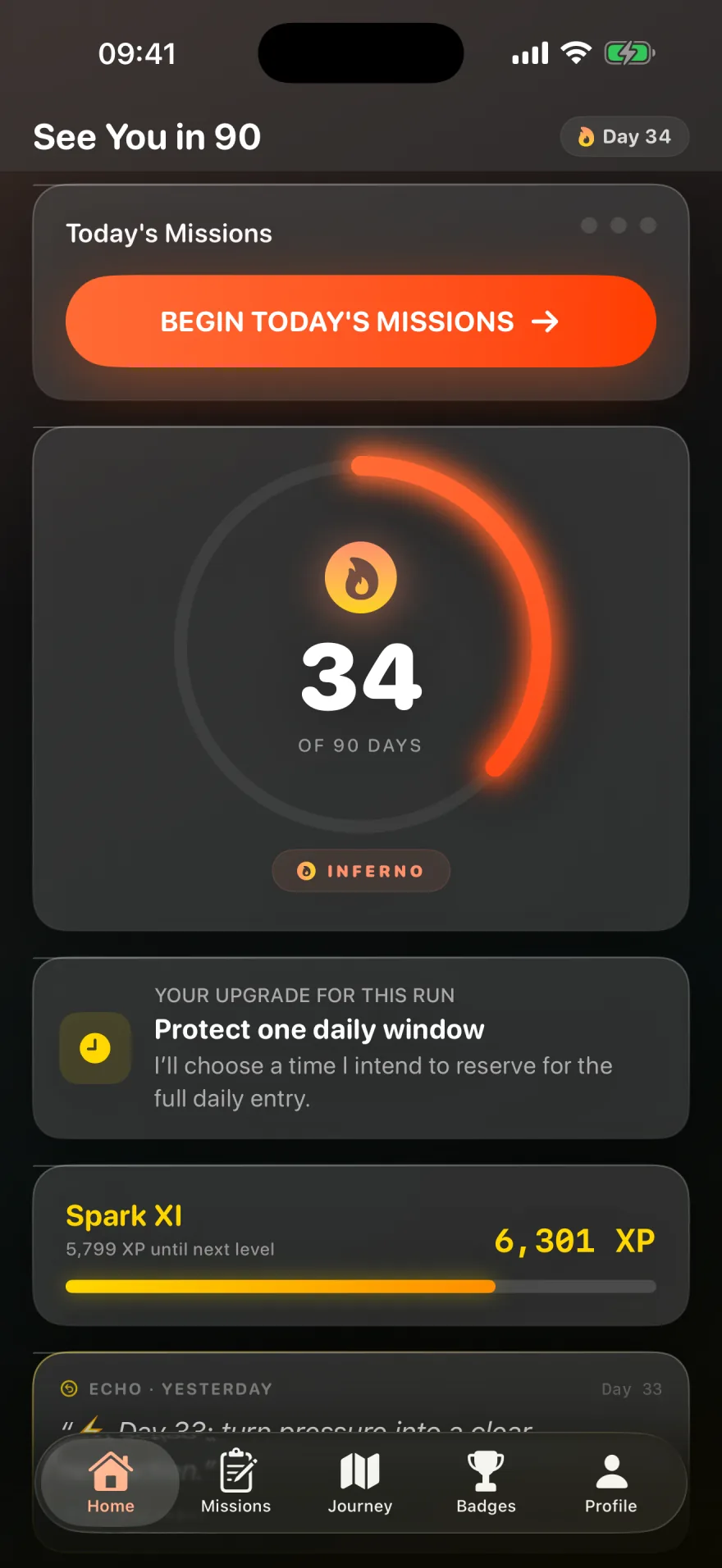
Only if that is part of the contract. See You in 90 uses consecutive days; the free calendar also supports a flexible window.
Should I track several habits at once?
This framework recommends one primary daily commitment so completion remains clear. That is a design recommendation, not a scientific limit.
What about illness, travel, or planned rest?
Define exceptions before starting or choose a flexible rule. Do not use a strict protocol when it would be unsafe or unsuitable.
What is a 90-day discipline challenge?
It is a broad label for practicing a defined commitment for 90 days, not one standardized set of rules. This guide uses one measurable action, an explicit tracking contract, and an honest daily record.
Is a 90-day challenge the same as 75 HARD?
No. 75 HARD is a separate named 75-day program with its own prescribed tasks. This guide describes a customizable 90-day habit and reflection challenge.
Where can I calculate the exact Day 90 date?
Use the separate Day 90 calculator and printable calendar after the action and tracking rule are decided.