
The three-part structure
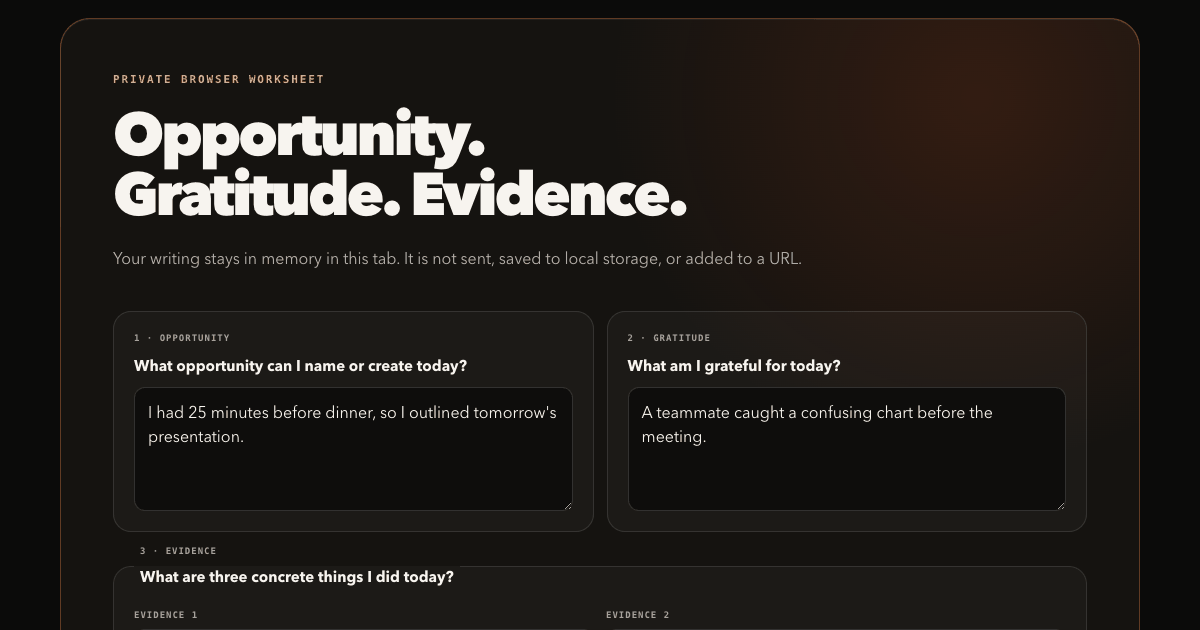
- OpportunityWhat opportunity can I name or create today?
- GratitudeWhat am I grateful for today?
- EvidenceWhat are three concrete things I did today?
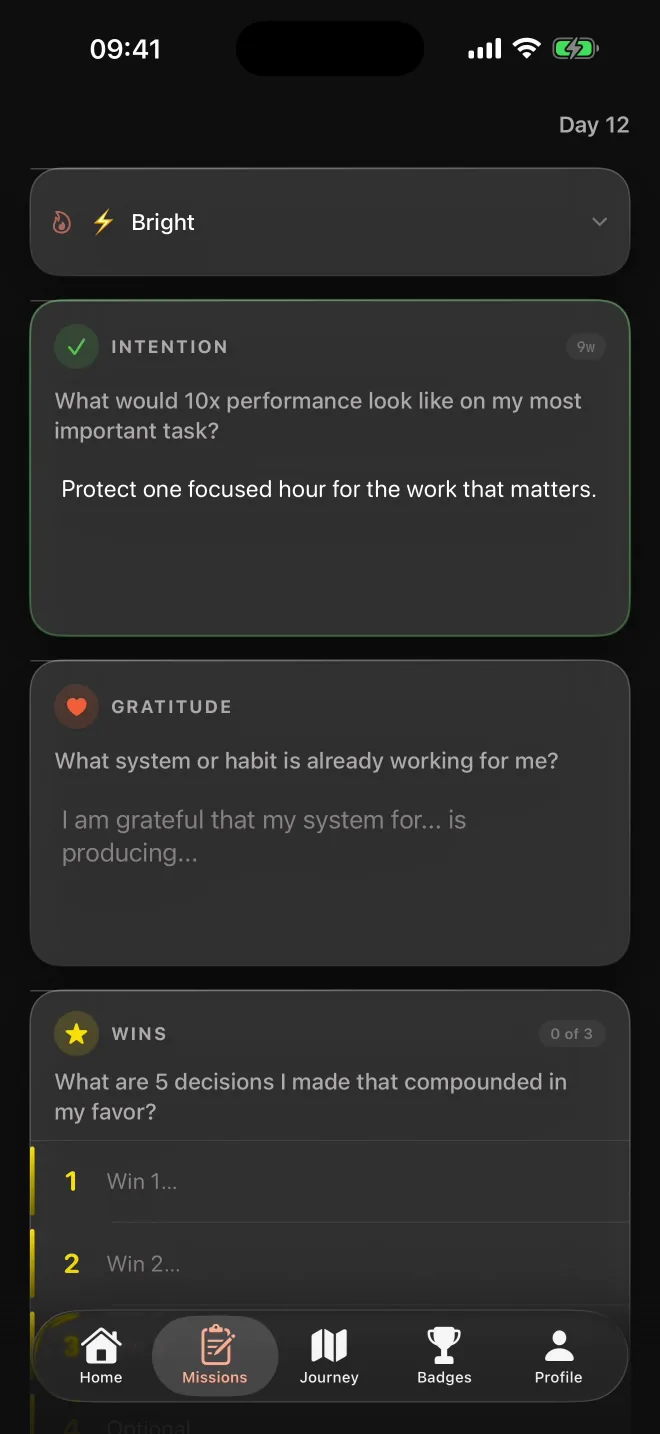
See You in 90 can rotate the wording by theme while preserving these three jobs. The app requires three evidence entries and offers room for two optional extras.
For a different day, ask: “What choice is open to me now?”, “Who helped me today, and how?”, and “What three actions can I point to?” These are examples of daily reflection questions, not extra required fields. Reuse the three jobs so entries remain comparable.
A filled daily reflection example
This is a fictional entry to show the level of detail. It is not a customer story, and you do not need to have a good day to complete the reflection.
A win can be small. Write what happened rather than a score for your character. In the app, these three wins are required. The fourth and fifth are optional. This page teaches a repeatable daily check-in, not a collection of 365 different prompts.
What is a daily reflection journal?
A daily reflection journal is a repeated check-in that helps you record what you noticed, appreciated, and completed. This method uses three stable jobs instead of an endless prompt list: name an opportunity, record one specific gratitude, and capture three concrete pieces of evidence from the day.
The questions are guided journal prompts, not a test. Short, specific answers are enough, and the same structure makes entries easier to compare across a longer commitment.
Pair reflection with a completion record
A checkmark records whether an action happened; a reflection records the context around it. After marking the action complete in your tracker, use this worksheet to record one specific gratitude and three good things or pieces of evidence you want to remember. Add a fourth and fifth entry when they are useful; the extra entries are optional.
For a custom action such as reading ten pages, keep its completion record in the blank paper habit tracker or the spreadsheet with evidence columns. Use the reflection here to explain what helped or got in the way; this worksheet does not check off that separate habit.
In this browser worksheet, your writing stays in the current tab unless you copy, download, or print it. In the current iPhone app, completed journal entries and challenge records are stored locally on the device.
Browser worksheet, iPhone app, or paper journal?
This private browser worksheet
Useful for trying the method now. Your text stays in the current tab unless you copy, download, or print it.
The See You in 90 app
A daily reflection app for iPhone that places the same three-part reflection method inside a consecutive 90-day challenge and preserves completed entries with the attempt.
A paper journal
Works without a device and can be completely free-form, but does not calculate the challenge or connect entries to an app timeline.
What is a gratitude journal—and how is this different?
A gratitude journal focuses on people, events, or details you appreciate. A digital gratitude journal or gratitude journal app may repeat that single practice each day. See You in 90 includes gratitude as one part of a broader reflection alongside opportunity and evidence of action.
Use a concrete gratitude prompt when the answer feels vague:
- Who made today easier, and what did they do?
- What small detail would I have missed if I had rushed?
- What resource, ability, or opportunity helped me today?
- What difficult moment taught me something useful?
- What ordinary part of today do I want to remember?
Why the jobs repeat
Repetition removes the need to search for a new prompt every day. It also creates a consistent record: openings you noticed, details you appreciated, and actions you can point to later. This is a practical design choice, not a claim that one reflection format is universally best.
Three good things—or five when you have more to record
“Good” does not need to mean dramatic. Use specific moments, helpful choices, or completed actions. For example:
- I put my phone away and ate breakfast without rushing.
- A friend sent a thoughtful note when I needed encouragement.
- I finished the first page of a task I had been avoiding.
- I took a short walk instead of continuing to scroll. (optional)
- I prepared tomorrow’s materials before ending the day. (optional)
A gratitude entry can overlap with one of these moments, but it has a different job: name what you appreciated and why it mattered. For example, “I appreciated my friend’s note because it reminded me I did not have to solve the problem alone.”
Fictional completed reflection example
This illustrative entry shows the level of specificity the worksheet is designed to capture. It is not a user testimonial or a promised result.
I had 25 minutes before dinner, so I used it to outline tomorrow’s presentation.
I am grateful a teammate pointed out a confusing chart before the meeting.
- I wrote the opening.
- I removed one unnecessary slide.
- I sent the draft before 6.
Adapt the evidence, not the structure
A specific sentence can be more useful than a long vague entry. The website worksheet has no word-count requirement and no missed-day penalty.
Daily reflection questions
When should I reflect?
Choose a repeatable time that fits your day. This method does not claim that morning or evening is universally better.
Do the answers need to be long?
No. A specific sentence can be more useful than a long vague entry. The app requires nonempty answers, not a minimum word count.
What if nothing important happened?
Record something small and observable: a task completed, a useful choice, or a moment you noticed.
What happens if I miss a reflection?
The website worksheet has no penalty. In See You in 90, an incomplete required day ends the active strict attempt.
Is my writing uploaded?
No. This worksheet runs locally in the current browser tab and does not transmit or persist the text.